Fighting over the app: how to stop the message becoming the argument
It’s rarely the event itself that starts the argument. A pickup that runs ten minutes late, a missing pair of shoes, a school trip payment that hasn’t landed yet — on their own, these are small things. What often turns a small thing into a ten-message back-and-forth is the tone of the first message, not the event it describes. This article is about exactly that: how to write the same message so it lands, instead of escalating.
Why tone matters more than content
A text message strips out everything that normally softens a conversation: tone of voice, facial expression, a brief pause. What’s left is word choice itself, and a reader tends to read that as more hostile than the writer intended — especially where there’s already tension between two co-parents. The same fact, worded differently, often decides whether a message gets a reply or a fight.
Four examples of the same message, different tone
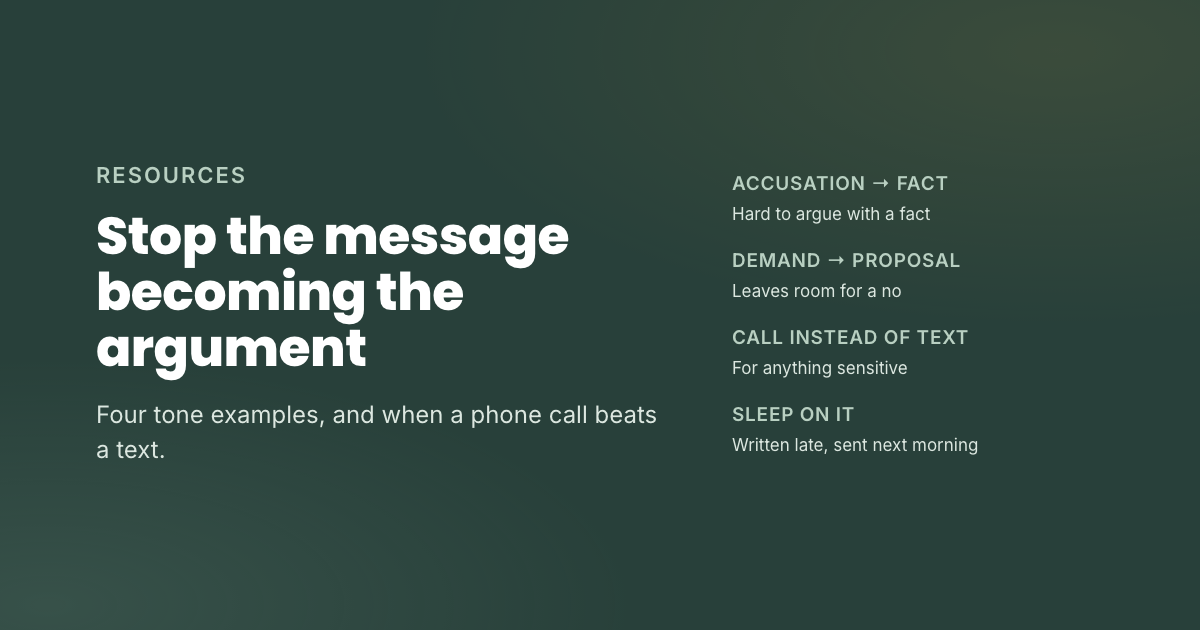
1. Accusation → fact. “You’re late picking her up again” reads as a charge, and almost automatically invites a defence. “She was picked up at 15:20, ten minutes later than agreed” describes the same thing, but is hard to argue with — it carries no assumption about why.
2. Demand → proposal. “You need to swap this weekend” leaves exactly two options: comply or fight. “Would swapping this weekend work? Let me know if that suits you” asks the same question, but leaves room for a no without that no becoming a conflict.
3. Exclamation mark → full stop. “She didn’t have a coat!! That’s not okay!!” and “She didn’t have a coat. Can you send one along on Monday?” say the same thing. The difference is punctuation — and tone reads faster in punctuation than in the words themselves.
4. Sarcasm → neutral. “‘Forgot’ again, sure” almost never reads as a joke, only as an attack. “I haven’t seen the payment come through yet — can you check whether it went through?” asks the same thing, without the insinuation.
When a phone call beats a text
Not every topic suits text. A back-and-forth that’s already three messages deep without resolving anything, a sensitive topic, or a question that needs more explanation than two sentences allow — those are exactly the moments where a two-minute phone call prevents a ten-message thread. The rule of thumb: once a message starts to feel like it’s more about the charge behind it than the content itself, that’s the signal to call instead of keep typing.
Sleeping on a message overnight
A message written late at night often reads sharper than it still feels the next morning. Anyone who notices they’ve typed something out of frustration comes out ahead by saving it as a draft and rereading it the next morning instead — often a line turns out to need cutting, or the message isn’t needed at all anymore.
What a neutral message looks like
A neutral message usually follows the same structure: the fact first, with no assumption about the cause, then a concrete request. “She was picked up at 15:20, ten minutes later than agreed. Can we make that on time tomorrow?” carries no accusation and is still completely clear about what’s being asked.
Checklist: before you hit send
Four quick checks on the tone of your message:
- Does it use an “I” statement instead of an accusation?
- Is the question phrased as a proposal, not a demand?
- No exclamation marks or capital letters used for emphasis?
- Written late? Sleep on it before sending.
None of these four is complicated on its own. Together, they keep the message itself from becoming the argument, instead of the small thing it was originally about.
Where the app helps
Messages in Zorgverdeling sit in the same shared schedule as whatever they’re about — no separate group chat next to a calendar nobody keeps updated. And right before you send a message, the app checks whether the tone reads as tense and, if so, suggests a calmer wording. Nothing forced — just a moment of reflection at exactly the point where most app-based arguments start.
That doesn’t make a hard conversation effortless. But it does remove the escalation that more often sits in tone than in the content of the message itself.
Start today with a clear co-parenting schedule
Invite the other parent and set up your schedule in a few minutes. Free for 21 days.