How to explain the schedule to your child, by age
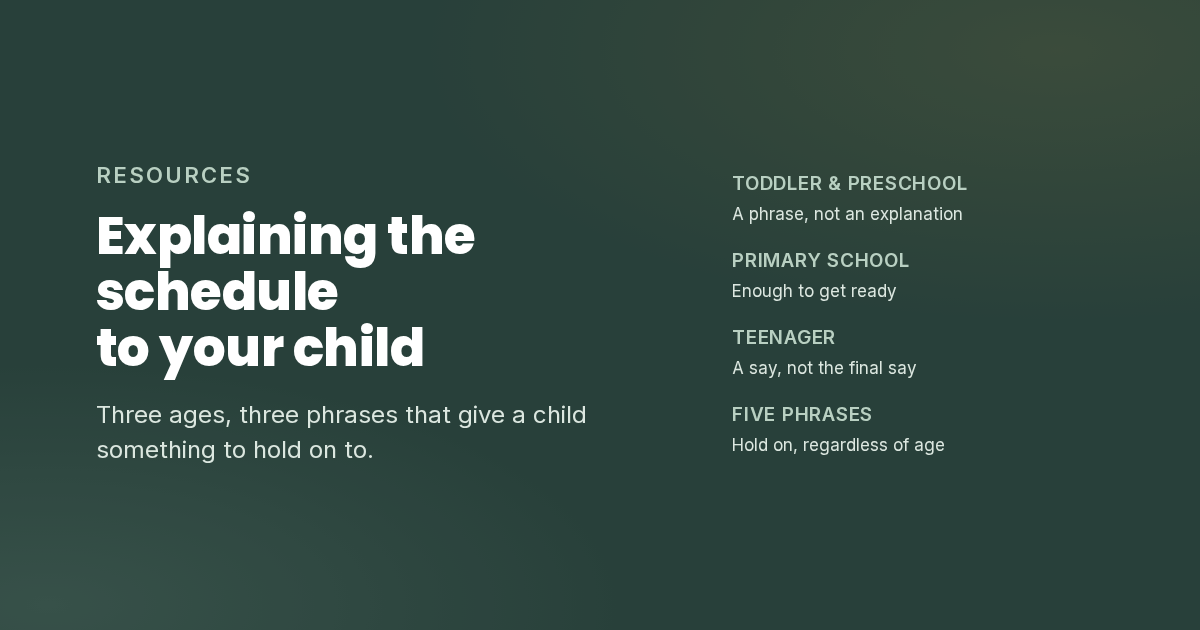
“How do you explain a schedule to a three-year-old, an eight-year-old, or a fourteen-year-old?” is really three different questions with three different answers. Yet many parents reach for the same explanation regardless of age — which means a toddler gets more explanation than they can use, and a teenager gets less room than they need. This article walks through three age brackets, each with a concrete phrase that gives a child something to hold on to instead of an explanation that gives too much at once.
Why age changes what a child can take in
A toddler doesn’t need a reason for a separation — they can’t make sense of one yet — but they do need a fixed, repeated phrase that makes a day predictable. A primary-school child can follow a schedule perfectly well once they know which house, which day, and who’s picking them up, but gets nothing out of the reason behind a disagreement between parents. A teenager can see the whole situation and wants to be heard rather than told — without “being heard” meaning they set the schedule themselves. Three very different needs, three different phrases.
Toddler and preschooler: a phrase, not an explanation
A toddler or preschooler doesn’t need a reason, just a fixed phrase that sounds the same every time: “Tonight you sleep at mum’s, tomorrow at dad’s.” No extra words, no advance notice of something that still has to happen — that fades at this age anyway. What does help: a simple calendar picture by the door or on the fridge, with a colour or icon per house, so a child can point to where they’re sleeping tonight instead of having to remember it.
Primary-school child: enough to get ready, not more than that
A primary-school child needs practical information: whose house they're going to after school, who's picking them up from sports, when they're going back to the other house. What they don't need: the content of a disagreement between the parents, who pays which amount, or who was "right." A workable phrase: “This week you're with me Monday through Wednesday, then with dad — same as last week.” At this age, the repetition of the pattern matters as much as the information itself.
Teenager: a say, not the final say
A teenager doesn't want to be presented with a done deal, but also shouldn't be handed the responsibility of setting the schedule themselves. The distinction sits in the question you ask: not “what do you want?”, but “what works for you, within what's possible?” For example: “The basic schedule stays the same, but if you've got training near dad's on Wednesdays, we can look at swapping that day.” That gives a teenager a say on details, without reopening the whole schedule decision by decision.
Five phrases that give a child something to hold on to, regardless of age
Regardless of age, a handful of phrases work for almost any child, because they're about what stays the same rather than what changes:
- “This doesn't change: we're both still your parents.”
- “You don't have to choose.”
- “Whatever's going on between mum and dad isn't something you need to worry about.”
- “If anything changes in the schedule, you'll hear about it in time — not by accident.”
- “It's okay to find it hard sometimes.”
None of these five is complicated on its own. Together, they make sure a child, regardless of age, knows what stays in place while everything else changes.
Where the app helps
In Zorgverdeling the schedule lives in one shared overview that doesn't depend on whoever happens to retell it that week. Through an ics feed, the same schedule can also show up in the calendar app of, say, a babysitter or grandparent — and, as a child gets older, in their own calendar. That turns “where am I supposed to be” into a question a child can look up themselves, instead of one they have to ask one of their parents.
That doesn't make the conversation itself unnecessary — the right phrase at the right moment is still down to the parents. But it does remove the uncertainty that creeps in once a schedule only exists in adults' heads.
Start today with a clear co-parenting schedule
Invite the other parent and set up your schedule in a few minutes. Free for 21 days.